

Related Posts


Clarification regarding the accreditation of a conformity assessment body for one legislation used (automatically) by the European regulator for another legislation
IntroductionPursuant to Article 2 (10) of Regulation (EC) No 765/2008, accreditation is defined as an attestation by a national accreditation…
30 May 2025
The EU CBAM and the role of accreditation
The EU Carbon Border Adjustment Mechanism (CBAM), which entered into force on 1 January 2026, is a climate policy tool designed to prevent carbon leakage and ensure fair competition between EU and non-EU producers.
27 Jan 2026
Accreditation of Notified Bodies – the AfN report was updated to include the new Construction Products Regulation
The AfN (Accreditation for Notification) report was just updated in April 2025 to cover one new piece of legislation: Construction Products…
28 Apr 2025
EN ISO/IEC 17025 for fire testing laboratories
A fire laboratory assesses the performance of a product by testing according to a test method.
21 Feb 2023
The EU Emission Trading System and the role of accreditation
The EU Emissions Trading System (EU ETS) is the first international emissions trading system. It was established in 2005 and is remaining the largest carbon market.
04 May 2023
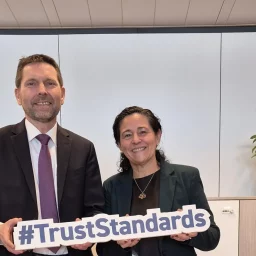
Renewal of the cooperation agreement between EA and CEN-CENELEC to strengthen the European Market
The European co-operation for Accreditation (EA) and the European Committee for Standardization (CEN) / European Electrotechnical Committee for Standardization (CENELEC)…
11 Mar 2025

Publication of the new international standards with the requirements for bodies performing inspection and certification of persons
ISO/IEC 17020:2026 and ISO/IEC 17024:2026 have been published by ISO respectively on 31 March and 1 April 2026
08 Apr 2026

Carbon Removals and Carbon Farming (CRCF) Regulation (EU) 2024/3012
In November 2025, the Implementing Regulation (EU) 2025/2358 laying down rules on certification schemes, certification bodies, and audits under Regulation (EU) 2024/3012 has been published in the Official Journal of the EU.
17 Mar 2026

From vision to reality: Strategic insights from the EA President and Vice-President
Maureen Logghe (BELAC, the Belgium National Accreditation Body) and Cecilie Laake (NA, the Norwegian NAB) have just been re-elected as EA President and Vice-President.
09 Jan 2025

Workshop on the Implementing Regulation (EU) 2024/2981 and the EUDI Wallet certification scheme
With support from the European Commission and ENISA, EA organized on the 27th of February an online workshop on the Implementing…
28 Feb 2025

Refresher Training for Team Members authorized for Product certification and Inspection
Refresher Training for Team Members authorized for Product certification and Inspection was held on June 6-7 2023.
19 Jun 2023

Publication of the European Quality Infrastructure Network (EQIN) Concept Note
EA is thrilled to announce the publication of the European Quality Infrastructure Network (EQIN) Concept Note
28 May 2025


Accreditation to provide safer and cleaner cars
Before the Diesel emissions scandal revelations in September 2015, the European Commission identified the need to address motor vehicle non-compliance.
11 Apr 2024