









Skip to main content Scroll Top

Annual Report 2025

FOREWORD

2025 has been a year of reflection and projection for EA. As EA marked its 25th anniversary, we also took decisive steps toward the future in publishing our Strategy 2030, a roadmap designed to ensure that accreditation continues to deliver trust, competence, and expertise in a rapidly evolving environment.

A key milestone was the launch of the EA MLA Mark, providing a clear signal of confidence, reliability, and European recognition for accredited services. At the same time, our engagement with the European Commission intensified, with a growing number of legislations referencing accreditation across sectors such as sustainability, digitalisation, and cybersecurity. These developments confirm the central role of accreditation in supporting the EU Single Market, while also highlighting the need to preserve the principles of Regulation (EC) No 765/2008 as the revision of the NLF (New legislative framework) progresses.

In 2025, EA continued to strengthen its system and its partnerships, from advancing technical work and peer evaluation to deepening cooperation with stakeholders and international partners. Workshops on AI and digitalisation, and new collaborations within the European Quality Infrastructure network, reflect a system that is both robust and evolving. Together, these efforts ensure that accreditation remains a trusted foundation, answering today’s challenges and those ahead.

Dr. Andreas Steinhorst
Executive Secretary

HIGHLIGHTS

2025-report-highlights-thumb

EA STRATEGY 2030

EA published its Strategy 2030 on November 2025, a forward-looking roadmap designed to ensure that accreditation continues to serve Europe’s citizens, businesses, and institutions with trust, coherence, and innovation at its core.

Our world is changing rapidly. Digitalisation, sustainability imperatives, emerging technologies like AI, and evolving global trade dynamics are transforming the way economies and societies operate.

Accreditation must not only keep pace with these developments but also shape the future by enabling trust in new markets, supporting innovation, and reinforcing Europe’s commitment to quality, safety, and resilience.

VISION
This forward-looking declaration – which expresses EA’s long-term goals and aspirations – outlines the future state we aim to achieve. EA envisions a trusted, balanced, resilient, and future-oriented accreditation system as a cornerstone of the European Quality Infrastructure — one that supports health, safety, sustainability, digitalisation, economic progress, and global trade, while strengthening Europe’s core values on accreditation and promoting them internationally.

MISSION
Our mission explains why we exist and what we do to achieve the defined goals. EA advances a future-ready accreditation system that builds trust, drives innovation, and delivers real value for society and trade. Through strategic digital transformation, effective peer evaluations, and strong collaboration among its members, EA proactively addresses global challenges while reinforcing Europe’s quality infrastructure. Working closely with European institutions, stakeholders, and international partners, EA ensures accreditation remains credible, resilient, and impactful across all sectors.

At the heart of this strategy lies our commitment to competence, transparency, and partnership — values that ensure accreditation remains a trusted foundation for regulation, trade, and public confidence.

To read the EA Strategy 2030, click here.

POSITION ON THE REVISION OF REGULATION (EC) NO 765/2008

Over more than a decade, the European accreditation system — based on a single national accreditation body (NAB) per Member State, operating on a non-profit basis, with independence, impartiality, and mandatory peer evaluation — has consistently ensured confidence, coherence, and mutual recognition of conformity assessment results across Europe and the Single Market.

The Regulation’s current framework applies to all accreditation activities, whether used on a compulsory or voluntary basis, relating to mandatory or voluntary conformity assessments, and irrespective of the legal status of the body performing accreditation. This comprehensive scope has been instrumental in guaranteeing mutual trust, enabling mutual recognition of certificates and results, supporting the free movement of goods and services, and promoting public confidence in both regulated and voluntary markets.

The revision of Regulation 765/2008 offers an opportunity to update certain provisions — for example to address digitalization and emerging technologies, and sustainability — but any changes must preserve the Regulation’s principles and scope. Altering them would risk fragmentation, weaken trust, and introduce legal uncertainty across the internal market and beyond.

EA published a position paper in November 2025 calling for the preservation of the core principles and scope of Regulation (EC) No 765/2008, which has established a robust and harmonised legal framework for accreditation within the European Union.

Download here the full EA position paper.

LAUNCH OF THE EA MLA MARK

EA launched on 1 September its Multilateral Agreement mark, the EA MLA Mark, as a new tool for the EA members and their accredited Conformity Assessment Bodies (CABs) to demonstrate competence, compliance, and confidence in the services they offer.

Its use shows that a Conformity Assessment Body has been accredited by a National Accreditation Body that is signatory to the EA MLA, and that this accreditation is equivalent and reliable across all EA member countries.

The EA MLA mark1 facilitates the mutual recognition of conformity assessment results across Europe, if the results have been issued under the EA MLA. This mark demonstrates that the National Accreditation Body is regularly peer evaluated, that the accreditation is performed to internationally agreed standards and legislations (if applicable), and that the accredited Conformity Assessment Body operates competently and impartially.

This builds confidence for regulators, customers, and markets

Accordingly, the EA MLA mark has a specific value in regard to the EU single market. Pursuant to Article 11 of Regulation (EC) No 765/2008 on accreditation, National Authorities shall recognise the equivalence of the services delivered by those National Accreditation Bodies2 which have successfully undergone peer evaluation by EA, and thereby accept the attestations issued by the Conformity Assessment Bodies accredited by them.

The EA MLA Mark is therefore more than a visual identifier. It is a clear signal of confidence, reliability, and European recognition: one mark with several meanings.

For further information, consult the dedicated page.

1 The EA MLA mark can be used by Conformity Assessment Bodies accredited by a National Accreditation Body, provided that the Conformity Assessment Body is established in a country where the mark has been registered. For the time being, the EA MLA mark is registered in: Albania, Algeria, Austria, Belgium, Bosnia & Herzegovina, Bulgaria, Croatia, Cyprus, Czech Republic, Denmark, Egypt, Estonia, Finland, France, Georgia, Germany, Greece, Hungary, Iceland, Ireland, Italy, Israel, Latvia, Lithuania, Luxembourg, Malta, Montenegro, Norway, Poland, Portugal, Republic of Moldova, Republic of North Macedonia, Romania, Serbia, Slovakia, Slovenia, Spain, Sweden, The Netherlands, Tunisia, Türkiye, Ukraine, United Kingdom.

2 National Accreditation Bodies from the EU/EEA (European Economic Area) and countries that have an (applicable) agreement with the EU.

COOPERATION WITH THE EUROPEAN COMMISSION

The cooperation with the European Commission regarding EU legislations and schemes with provisions on accreditation and conformity assessment is one of EA’s key tasks.

The involvement of EA and its members in EU legislations and schemes is crucial to ensure that accreditation and conformity assessment are applied according to the European accreditation legal framework.

In 2025, 10 new EU legislations with provisions on accreditation and conformity assessment were published in the Official Journal of the EU.

They are related to the following sectors:

  • Union Harmonisation Legislations (Legislations based on the New Legislative Framework);
  • Climate / Environment;
  • Sustainability / Ecodesign / Green Transition;
  • Transport;
  • Data Protection;
  • Cybersecurity / IT Security.

More details are available in the document EA-INF/05, which lists a comprehensive directory of the published EU legislations and schemes with requirements on accreditation and conformity assessment.

End of 2025, there were 152 (142 end of 2024) EU legislations relevant for accreditation and conformity assessment on:

EA 25TH ANNIVERSARY

2025 marks the 25th anniversary of EA – and what a journey it has been. A journey paved by the unwavering commitment to placing accreditation where it belongs: as the best tool to demonstrate competence and impartiality in controls about conformity and confidence in services and products.

This journey has been shaped by the dedication of women and men working together – despite, or perhaps thanks to, their cultural differences – to harmonise their approaches and evolve with one voice, and we want to seize this opportunity to thank all of them.

While we are bound by Regulation (EC) No 765/2008, our true strength lies even beyond this regulation:

  • 47 members collaborating to form a strong, non-competitive alliance;
  • Over 35,000 accreditations delivered by EA Members under the EA MLA framework – an increasing number of scopes, with 44 MLA signatories, 14 of whom have declared their intention to use the MLA mark to more clearly demonstrate the compliance of Conformity Assessment Bodies end of December 2025;
  • More than 150 EU regulations and directives referencing accreditation – and increasing confidence from the European Commission, directly impacting the benefit of the European Single Market;
  • 40 stakeholders working daily with EA to ensure that the European accreditation system remains credible and effective across all sectors;
  • 9 people in the EA Secretariat – soon to be 10! – supporting EA Members and keeping the system running like a well-oiled machine.

But EA is not defined by numbers alone. It is built on the shared commitment of its Members to promote the European Accreditation system across the globe.

“Alone, we go fast. Together, we go further.”

EA-25-anniversary

NEW EA WEBSITE

EA launched its new website on 20 November. It is fully responsive and SEO-oriented to facilitate the understanding of accreditation and conformity assessment for a broader audience.

The General Search now scans all EA documents, and the FAQ system has been revised. This will enable visitors to easily find the right document and the answers to their questions.

SCC/EA RENEWAL PARTNERSHIP

The Standards Council of Canada (SCC) and the European co-operation for Accreditation (EA) have renewed their bilateral cooperation agreement, which includes extending the review period from three to five years.

The cooperation agreement, first signed in 2016, establishes the framework for collaboration between the two organizations in implementing the Protocol on the mutual acceptance of conformity assessment results under the Canada–European Union Comprehensive Economic and Trade Agreement (CETA). Through this protocol, recognized conformity assessment bodies in Canada and the EU can certify products to each other’s technical requirements, enabling a faster, more cost-effective pathway to access foreign markets while upholding consumer confidence.

The agreement enhances cooperation and supports trade diversification, enabling businesses to expand into new markets with confidence that their accredited results will be accepted on both sides of the Atlantic.

The amendment is a strong signal of the deepening relationship between the two organizations and highlights their shared, long-term commitment to advancing accreditation and the use of conformity assessments to make trade easier for Canadian and EU businesses.

EQUIN CONCEPT NOTE PUBLICATION

EA published, along with the European Quality Infrastructure Network (EQUIN) partners a Concept Note to offer insights on the Quality Infrastructure definition, role, and functioning, including the importance of this collaborative Network in strengthening and promoting the QI in Europe. EQUIN was created in March 2024 and aims to support and enhance the quality, safety, and environmental soundness of goods, services, and processes for consumers and businesses.

The Network Partners are organizations that represent the key pillars of the European Quality Infrastructure (QI):

  • Metrology: EURAMET – The European Association of National Metrology Institutes, WELMEC – European Cooperation in Legal Metrology;
  • Standardization: CEN – European Committee for Standardization and CENELEC – European Committee for Electrotechnical Standardization;
  • Accreditation: EA;
  • Market Surveillance: PROSAFE – The Product Safety Forum of Europe;
  • Conformity Assessment: EUROLAB.

Click here to read the Concept Note.

TECHNICAL MATTERS

2025-report-technical-thumb

CLARIFICATION REGARDING THE ACCREDITATION OF A CAB FOR ONE LEGISLATION USED (AUTOMATICALLY) BY THE EUROPEAN REGULATOR FOR ANOTHER LEGISLATION

There are EU legislations, which include that an accredited conformity assessment body for a certain EU legislation shall be an accredited conformity assessment body for the purpose of another EU legislation.

Such provisions in EU legislations create different issues:

  1. The conformity assessment body has not been assessed for the purpose of the other EU legislation in order to demonstrate that the (additional) requirements set out in the legislation are fulfilled.
  2. The conformity assessment activities are not covered in the scope of accreditation and accordingly not included in the accreditation certificate, unless the conformity assessment body has applied for accreditation for this specific activity.
  3. The conformity assessment body cannot claim to be accredited for this activity, because it is not part of the scope of accreditation and included in the accreditation certificate.
  4. Because this activity is not part of the scope of accreditation, the conformity assessment body will not be monitored by the national accreditation body (for this activity).
  5. Granting accreditation, including the scope of accreditation, is exclusively under the responsibility of the National Accreditation Body.

Therefore, the European regulator is requested to avoid in legislations any provision which can be deemed as an ‘automatic’ or ‘transferred’ accreditation. Any accreditation of conformity assessment bodies, including the scope of accreditation, is under the responsibility of the national accreditation body only.

A conformity assessment body shall apply for accreditation, or scope extension, to its national accreditation body in order to become accredited for the purpose of a certain legislation. This applies also to legislations, which include a provision that the accreditation under a certain legislation can be used for the legislation concerned.

The conformity assessment body can use the accreditation symbol or other claims of accreditation only, if the relevant specific activity (including the reference to the legislation concerned), is included in the accreditation certificate/information.

Click here to download the publication with additional information.

TMB RESOLUTION 2025-03-21–1: EVALUATION OF CONFORMITY ASSESSMENT SCHEMES

The Technical Management Board, acting upon recommendation from the Horizontal Harmonisation Committee (HHC), approves that, while EA-1/22 EA procedure and criteria for the evaluation of conformity assessment schemes by EA accreditation body members is not updated and implemented, in case the home-National Accreditation Body (hAB) has not concluded a scheme evaluation after 2 years, each National Accreditation Body is allowed to ask for a status report to the hAB, to perform its own analysis of the scheme according to the requirements of EA 1/22 and then decide to provide accreditation or not, while reporting its conclusions to the hAB.

TMB RESOLUTION 2025 (22) 01: ACCREDITATION SCOPES REGARDING ENERGY MANAGEMENT SYSTEMS CERTIFICATION

The Technical Management Board, acting upon the recommendation of the EA Certification Committee, resolves that scoping for the accreditation of Energy Management Systems certification is done referencing at least the following technical area scopes:

A: Industry – light to medium
B: Industry – heavy
C: Buildings
D: Building complexes
E: Transport
F: Mining
G: Agriculture
H: Energy Supply

The NAB should also consider these clusters as sectors, as mentioned in IAF MD17:2023 Witnessing Activities for the Accreditation of Management Systems Certification Bodies to determine assessment regimes (witnessing, etc.).

ACCREDITATION OF NOTIFIED BODIES – REVISION OF EA-2/17 AND UPDATE OF THE AFN REPORT

The EA Working Group ‘Accreditation for Notification (AfN)’ started in 2025 the revision of EA 2/17 EA Document on Accreditation for Notification Purposes. It aims to improve clarity, consistency, and harmonisation in the application of the mandatory document across EA members when accrediting conformity assessment bodies for the purpose of notification. Key objectives of the revision included updating terminology, improving the structure and readability, revising tables, and incorporating several new Union Harmonisation Legislation (UHL) into the document. In addition, a new chapter on subcontracting has been introduced, along with three new supplements on non-aligned legislations (in the context of Decision No 768/2008/EC on a common framework for the marketing of products), examples of accreditation scopes, and Construction Products Regulation (CPR).

The AfN report was updated in April 2025 to cover one new piece of legislation: Construction Products Regulation (EU) 2024/3110 («new» CPR).

The AfN report can be deemed as a supplement to EA-2/17, and includes for each Union Harmonization Legislation the preferred harmonised standard which shall be applied for the accreditation of conformity assessment bodies for notification purposes.

The AfN report can be downloaded from the EA website.

TRAININGS,
WORKSHOPS,
AND WEBINARS

2025-report-trainings-thumb

AI WORKSHOPS

Almost 200 participants attended the first workshop organized by EA for its members on Artificial Intelligence (AI) and its use by National Accreditation Bodies (NABs) on 9 October 2025.

The first part of the workshop covered the following topics:

  • AI hype cycles;
  • Using Generative AI in the accreditation tasks;
  • Which tasks can be automated, and what shall be controlled by a human?
  • How AI will change NABs’ way of working;
  • The agent revolution: AI frameworks act as decision makers;
  • AI workflows and implications for the accreditation process.

The second part focused on the use of AI by a Conformity Assessment Body. One of Europe’s largest such organizations shared its experiences, highlighting how AI can enhance operational efficiency while also illustrating the current limitations of AI in conformity assessment activities.

EA held a second workshop on Artificial Intelligence and its use by National Accreditation Bodies (NABs) on the 30th October 2025, bringing together 170 participants from EA Members. The event highlighted concrete experiences, operational insights, and ongoing digital transformation efforts within several NABs.

WORKSHOP ON IT SYSTEMS FOR THE OPERATION OF A NAB

Accreditation plays a vital role in ensuring trust, quality, and compliance across all sectors, especially in the increasingly regulated sectors. The efficiency of a National Accreditation Body (NAB) hinges not only on its technical capacity and competence, but increasingly also on the strength of its IT infrastructure. An appropriate IT system can significantly enhance the operations of a NAB by improving efficiency, transparency, traceability, reporting, and quality assurance.

EA organized a workshop for its members on IT Systems for the operation of a National Accreditation Body, attended by over 100 participants, to present three IT systems conceived by 3 EA National Accreditation Bodies: HAA (Croatia), TURKAK (Türkiye), and UKAS (UK).

WORKSHOP ON THE IMPLEMENTING REGULATION (EU) 2024/2981 AND THE EUDI WALLET CERTIFICATION SCHEME

With support from the European Commission and ENISA, EA organized on the 27th of February 2025 an online workshop on the Implementing Regulation (EU) 2024/2981 laying down rules for the application of Regulation (EU) No 910/2014 as regards the certification of European Digital Identity Wallets, and the State of Play regarding the EUDI Wallet certification scheme.

The European Commission (DG CNECT) and ENISA provided insights into the certification framework and the role of National Accreditation Bodies (NABs) and Conformity Assessment Bodies (CABs). The certification includes the whole of products, processes, and services that compose the EUDI Wallets.

The discussion highlighted the need for harmonized certification requirements across Member States to ensure interoperability and trust in EUDI Wallets. A key challenge remains to align national certification schemes with the future Cyber Security Act-based European certification framework while maintaining flexibility for national approaches in the transitional phase.

The workshop introduced the risk register, a key tool designed to address cybersecurity threats and ensure that certification schemes adequately mitigate risks. The workshop dealt with the finalisation of the Implementing Act, clarifying certification methodologies, and guaranteeing a smooth transition from national schemes to a fully harmonized European framework.

Member States were encouraged to actively contribute to working groups and consultations to refine the certification process. The workshop reinforced the importance of cooperation and strategic planning in building a secure and effective digital identity ecosystem across Europe.

A first draft of the European Wallet certification scheme is in preparation by ENISA and is expected in 2026. The European scheme shall be published as an Implementing Act by the end of 2026.

MAC REFRESHER AND NEWCOMER TRAINING

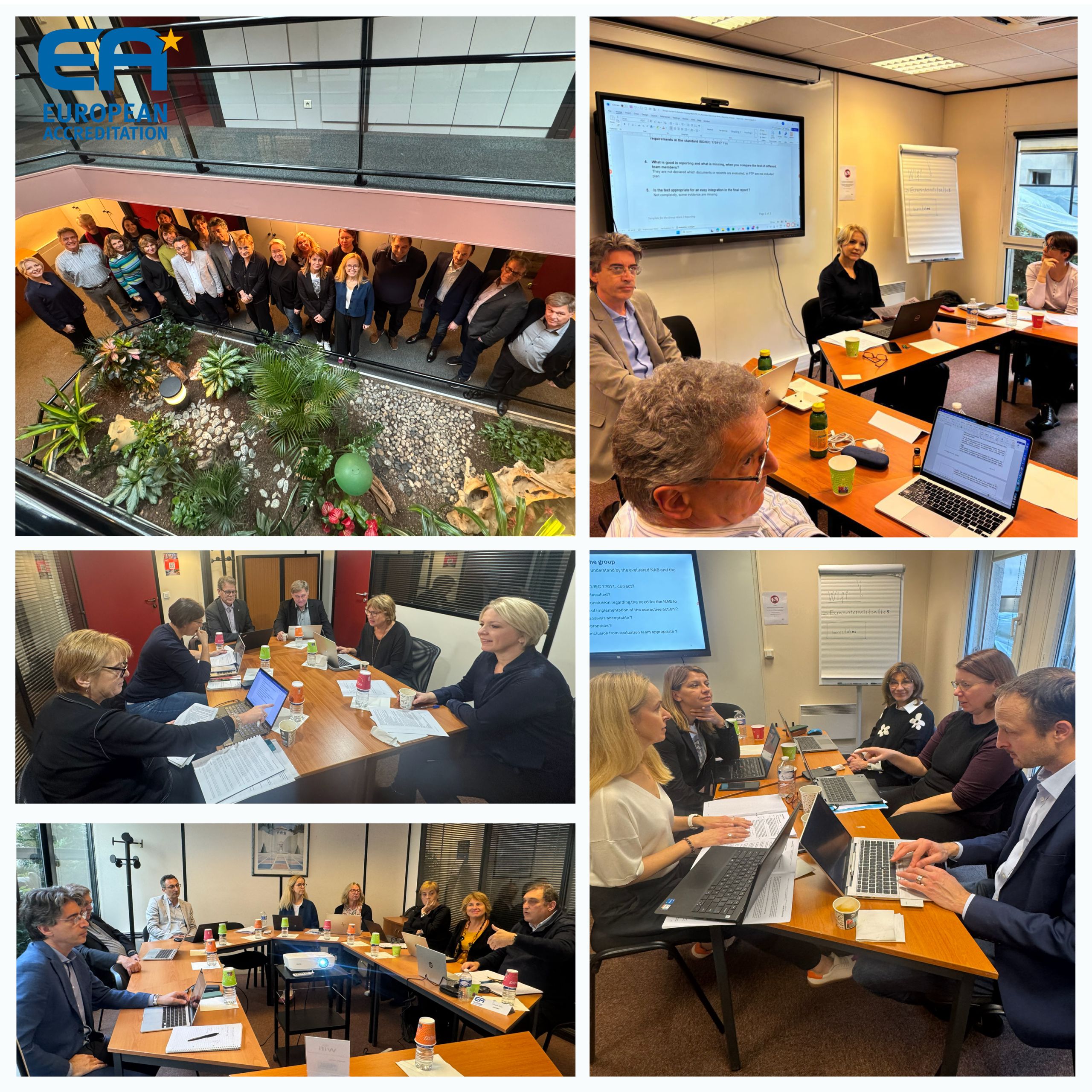
EA regularly organizes refresher and newcomer training sessions for peer evaluators.

Refresher training sessions aim to improve the performance and harmonisation of peer evaluations. This includes that EA evaluators are informed about new requirements, changes in peer evaluation procedures, and areas for improvement, and share their experience with their peers.

Three Refresher training sessions took place in 2025:

  • Product certification and Inspection on 23-24 June;
  • Medical Examinations and Proficiency Testing Providers on 5-6 November;
  • Team Leader and Deputy Team Leader on 10-11 November.

Refresher Medical Examinations and PTP
5-6 November, Paris, France

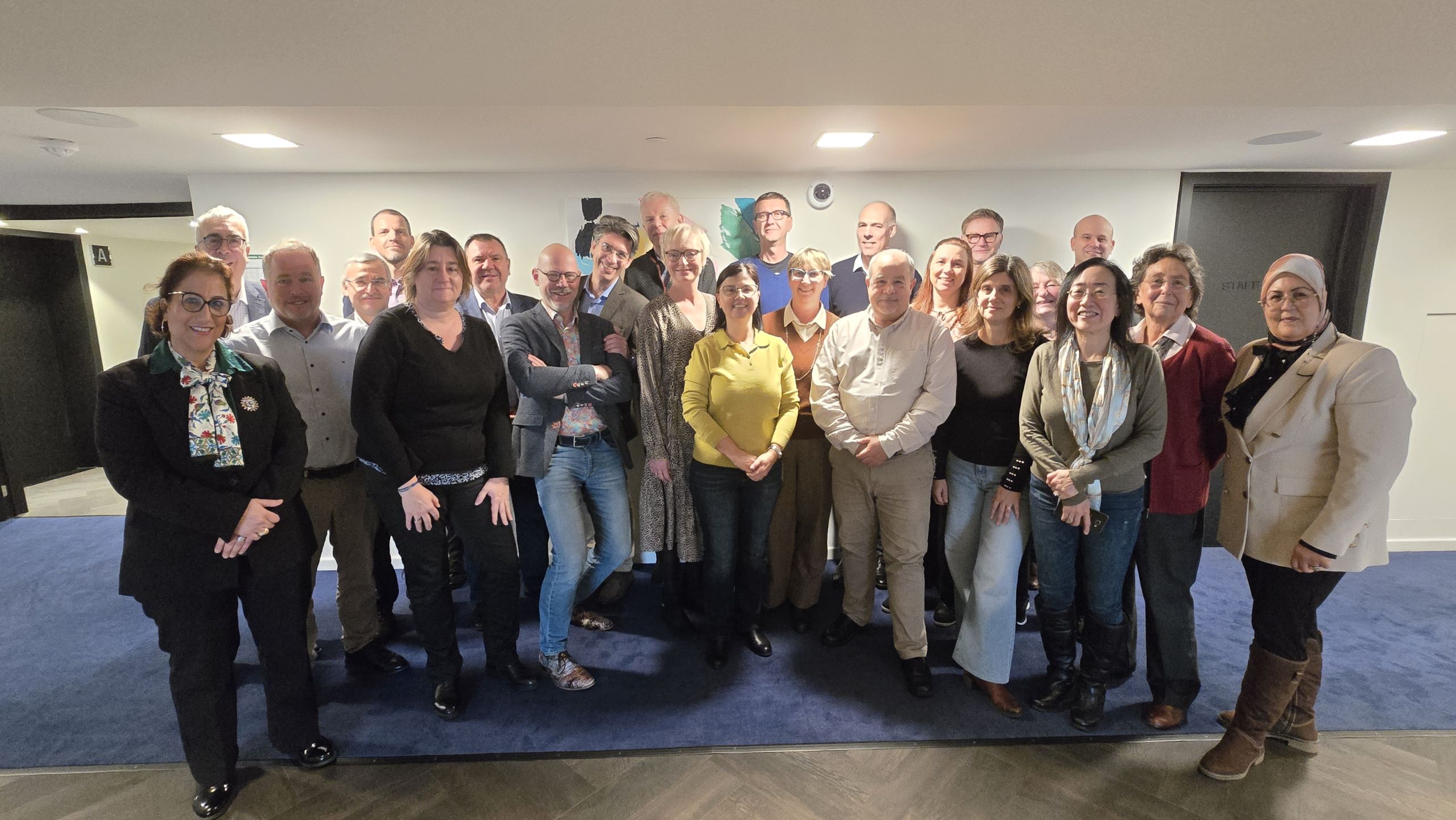
Refresher TL and DTL
10-11 November, Brussels, Belgium

Refresher Product Certification and Inspection
23-24 June

EUROPEAN
COMMISSION
AND STAKEHOLDERS

2025-report-EC-thumb

EUROPEAN DATA PROTECTION BOARD

EA has been working closely with the European Data Protection Board (EDPB) to strengthen cooperation in the context of the General Data Protection Regulation (GDPR) and related conformity assessment activities. This collaboration aims to improve mutual understanding of their respective evaluation processes on certification schemes and to ensure a more consistent and efficient approach across Europe.

A key outcome of this joint effort is the development of a best-practice approach for evaluating certification schemes, supporting the effective implementation of the EU data protection seal and enhancing the overall quality and reliability of certification processes. The cooperation also seeks to streamline procedures and promote well-functioning schemes that can be applied consistently across different countries.

Through ongoing dialogue, both organizations have worked to address practical challenges and align their approaches, reflecting a strong and constructive partnership. A coordinated framework for the parallel evaluation of certification schemes has been developed and is expected to be finalized and published in 2026.

COOPERATION WITH ESMA AND CEAOB

The European co-operation for Accreditation (EA) is cooperating with the European Securities and Markets Authority (ESMA) and the Committee of European Auditing Oversight Bodies (CEAOB) on the implementation of Directive (EU) 2022/2464 (CSRD).

A key aspect of this cooperation concerns the interplay between accreditation standards and the standards applicable to statutory auditors in the context of sustainability reporting.

The EU Omnibus Package February 2026 introduces several changes to the CSRD framework, including higher thresholds for applicability (e.g. number of employees and turnover), a two-year postponement of reporting requirements to 2027/2028, and the removal of sector-specific European Sustainability Reporting Standards to reduce administrative burden.

As a result, the number of potential certification bodies under the CSRD is expected to decrease significantly. Nevertheless, several National Accreditation Bodies within EA have already begun accrediting certification bodies for CSRD-related activities in 2025.

RED III – EVALUATION OF SCHEMES

The Directive (EU) 2018/2001 (RED) establishes the legal framework for the development of renewable energy across all sectors of the EU economy and represents a key component of the EU’s Green Deal. It has been further strengthened by Directive (EU) 2023/2413 (commonly referred to as RED III).

Within this framework, and in accordance with Implementing Regulation (EU) 2025/196, a certification body operating under voluntary or national scheme(s) must be accredited in accordance with Regulation (EC) No 765/2008 by its National Accreditation Body. The accreditation shall cover the specific certification scope defined by the respective scheme.

As part of the assessment of voluntary or national schemes in accordance with Directive (EU) 2018/2001, the Commission shall assess, after consulting EA, if the methodologies, rules, and protocols of the voluntary or national schemes are suitable for accreditation for the purposes of this Directive. The conclusion of the assessment of the voluntary and national schemes’ suitability for accreditation shall be included in technical assessment reports, prepared by the Commission and presented to the Member States as part of the voluntary and national schemes recognition process.

The European co-operation for Accreditation (EA) has cooperated closely with the European Commission (DG ENER) in implementing these requirements, particularly regarding the evaluation of voluntary schemes. EA assessed approximately 15 such schemes to determine their suitability for accreditation. By the end of 2025, 12 schemes had been found suitable, and the results were submitted to the European Commission.

BREAST CANCER SCHEME

The Joint Research Centre of the European Commission released the European Quality Assurance Scheme for Breast Cancer Services. This voluntary scheme sets robust, evidence-based requirements designed to improve the quality and equity of breast cancer screening and care across Europe. Key highlights of the scheme:

  • Evidence-based and patient-centred
  • Ensures continuity of care throughout the entire breast cancer care pathway
  • Modular and flexible – covering screening, diagnosis, treatment and supportive care while considering the various organisation of healthcare infrastructures across Europe.

EA endorsed this scheme, where the scheme shall be applied for the accreditation of Conformity Assessment Bodies certifying under the European Commission Initiative for Breast Cancer Care (ECIBC).

For more information, visit the web-hub: European Commission Initiatives | Cancer screening, diagnosis and care.

ERA ORGANIZES A HYBRID WORKSHOP ON ‘NOBO MONITORING-RETURN OF EXPERIENCE’

The European Union Agency for Railways (ERA) organised a one-day hybrid workshop focused on ‘NoBo Monitoring-Return of Experience,’ on 18 February 2025 in Brussels, Belgium. This event brought together key stakeholders in the railway sector to share insights and experiences related to the monitoring of Notified Bodies (NoBos) regarding the EU Directive on the interoperability of the rail system.

The workshop featured a presentation from EA, along with other insightful sessions and discussions, and this event provided a unique opportunity to exchange knowledge and best practices in NoBo monitoring, fostering collaboration and improvement in railway safety and standards.

EU CBAM

The EU Carbon Border Adjustment Mechanism (CBAM), which entered into force on 1 January 2026, is a climate policy tool designed to prevent carbon leakage and ensure fair competition between EU and non-EU producers. CBAM puts a carbon price on certain imported goods that is equivalent to the carbon price EU producers pay under the EU Emissions Trading System (EU ETS).

It concerns sectors producing iron and steel, cement, aluminum, fertilizer, electricity, and hydrogen.

If those products using carbon-intensive processes are made outside the EU, the importer shall pay for the embedded emissions when bringing them into the EU.

The embedded emissions shall be verified by an independent body (verifier) that is accredited according to Regulation (EC) No 765/2008 by an EU (EEA) National Accreditation Body (NAB).

National Accreditation Bodies ensure that verifiers possess the necessary competence to understand the technical processes carried out by installations and to assess the specific monitoring and reporting boundaries of an installation, depending on the goods produced. For this purpose, a separate accreditation scope is being created for each relevant CBAM activity group, so that National Accreditation Bodies are able to evaluate the verifier’s competence and performance against specific criteria depending on the particular scope of accreditation.

In November 2025, the European Commission published the Delegated Regulation (EU) 2025/2551 on supplementing Regulation (EU) 2023/956 (CBAM) by specifying the conditions for granting accreditation to verifiers, for the control and oversight of accredited verifiers, for the withdrawal of accreditation and for mutual recognition and peer evaluation of accreditation bodies.

According to the EU CBAM Regulation and the Delegated Regulation 2025/2551, a verifier located in the EU shall apply for accreditation to its National Accreditation Body. Verifiers established in a third country shall request a National Accreditation Body from the EU that provides accreditation under EU CBAM to grant accreditation.

Where the National Accreditation Body provides accreditation services under EU CBAM but is unable to carry out the accreditation of a verifier established in a third country, the National Accreditation Body – with the support of EA – will help those verifiers to find a National Accreditation Body that can provide accreditation in the third country concerned.

The first CBAM declarations, in respect of the calendar year 2026, shall be submitted by 30 September 2027 to the competent authority of the EU Member State where the authorized CBAM declarant (usually the EU importer) is established, via the CBAM registry. These annual declarations shall include embedded emissions data that have been verified by an accredited verifier.

You find more information about EU CBAM on the European Commission’s website.

EA ADVISORY BOARD

Further to Andrew Evans’ (CAPIEL) stepping down from the EA Advisory Board (EAAB) Industry College and chair position for which he had been elected in November 2024, the EAAB elected Alexander Šafařík-Pštrosz (EUROLAB), the CAB College Chair, as the EAAB Chair for the term of the Board terminating in November 2027. He will be supported by two Vice-Chairs, i.e. Ariane Van Cutsem (Belgium), the National Authority College Chair, and Jonas Gock (ORGALIM), the newly nominated Industry College Chair.

The EAAB continued to follow up on EA’s constant work and efforts undertaken:

  • to cope with the challenges posed by the implementation of all the regulations addressing new technologies and sustainability, and
  • to pursue the ongoing dialogue with the various services of the European Commission and regulators to establish harmonised conditions for the implementation of these new regulations.

The EAAB contributed to the discussions and sent comments for the revision of EA-1/15 EA Policy for relations with Stakeholders (published) and EA-2/17 EA Document on Accreditation for Notification purposes.

Four new Recognised Stakeholder agreements were concluded with the following associations, most of which are very familiar with EA, in the second semester of 2025:

  • ETSI (European Telecommunications Standards Institute), whose previous Memorandum of Understanding (MoU) was turned into a Recognised Stakeholder agreement;
  • FAMI-QS (The Quality & Safety System for Specialty Feed Ingredients), whose previous agreement had been terminated in July 2022;
  • Eurocer-Building (the association of product certification bodies in Europe active in the construction sector);
  • ExNBG (European Coordination Group of ATEX Directive (2014/34/EU) Notified Bodies).
EA Advisory Board Meeting on 12 May 2025, Brussels, BELGIUM

INTERNATIONAL
MATTERS

2025-report-intl-thumb

GLOBAL ACI – UPDATE

In October 2025, members and stakeholders of the International Accreditation Forum (IAF) and the International Laboratory Accreditation Cooperation (ILAC) convened in Bangkok, Thailand, for the second General Assembly of the newly established Global Accreditation Cooperation Incorporated. The meeting took place during the IAF/ILAC Joint Annual Meetings and marked an important step in the transition toward a unified global accreditation structure.

The General Assembly Global Accreditation Cooperation Incorporated represented a significant milestone, including the formal initiation of the wind-down process for IAF and ILAC.

Membership of Global Accreditation Cooperation Incorporated expanded considerably, with numerous applications approved ahead of the meeting. In total, the organization reached 159 members, including Full, Associate, and Stakeholder Members, alongside Regional Cooperation Bodies.

Key procedural and guidance documents were adopted, enabling Global Accreditation Cooperation Incorporated to operate as a fully functional organization from 1 January 2026. Important steps were also formalised regarding the establishment of the new MRA, as well as the transfer and continued use of existing recognition marks. Work is ongoing to finalise the remaining documentation required for the operational start of the new organisation.

During the General Assembly, Brahim Houla of the GCC Accreditation Center (Saudi Arabia) and Emanuele Riva of ACCREDIA (Italy) were elected as Chair and Vice Chair respectively. Both will begin their three-year terms on 1 January 2026, coinciding with the official launch of Global Accreditation Cooperation Incorporated.

NUMBERS 2025

International Accreditation Forum (IAF)

  • 99 Accreditation Body Members
  • 90 MLA Signatories representing 102 economies
  • 33 Association Members
  • 6 Recognised Regional Accreditation Groups (AFRAC, APAC, ARAC, EA, IAAC, SADCA)

International Laboratory Accreditation Cooperation (ILAC)

  • 121 Full Members (signatories to the ILAC MRA) representing 122 economies
  • 15 Associates representing 18 economies
  • 23 Stakeholders
  • 6 Regional Cooperation Bodies (ARAC, EA, IAAC, APAC, AFRAC, SADCA)

IT AND
COMMUNICATIONS

2025-report-it-thumb

VIDEOS PRODUCED IN 2025

Three videos were published in 2025 to introduce the EA President and Vice President, elected for their third and last term, to present the Horizontal Harmonization Committee, the Inspection Committee, and to come back on the 25th Anniversary of EA and its values and challenges.

WAD 2025

This year’s theme, Empowering Small and Medium Enterprises (SMEs), highlighted how accreditation and the broader quality infrastructure system can support and strengthen SMEs.

According to the World Trade Organization, 95% of businesses worldwide are SMEs, employing fewer than 250 people. They account for 60–70% of employment and 55% of GDP in developed economies, and contribute up to 40% of gross national income (GNI) in emerging economies.

In 2024, the European Union (EU) registered 26.1 million SMEs. Emerging markets alone host an estimated 365–445 million SMEs globally. Despite their central role in global economies, SMEs face major challenges: competing with larger organizations, accessing finance, managing rising costs, bearing compliance burdens, and breaking into new markets.

The EU’s single market enables the free movement of people, services, capital, and goods. Thanks to mutual recognition, any product lawfully sold and compliant in one EU country can be sold across all others.

WEBSITE NUMBERS 2025

PUBLICATIONS

2025-report-publications-thumb

DOCUMENTS PUBLISHED IN 2025

Governance and Policy documents

EA-1/06EA Multilateral Agreement. Criteria for Signing. Policy and Procedures for Development
EA-1/15EA Policy for Relations with Stakeholders


Members’ Procedural documents

EA-3/01EA Conditions for the Use of Accreditation Symbols, Logos and other Claims of Accreditation and Reference to the EA MLA Signatory Status
EA-3/01S1 Rules on the Use of EA MLA Mark
EA-3/01S2 Rules on the Use of EA MLA Mark in the UK
EA-4/22EA Guidance on Accreditation of Pesticide Residues Analysis in Food and Feed
EA-4/24Guidelines for the Accreditation of Laboratories carrying out Genetic Testing using Next Generation Sequencing (NGS) Techniques


Peer Evaluation Process documents

EA-2/02EA Procedure for the Evaluation of a National Accreditation Body


Secretariat Management System and Operational documents

EA-0/10Procedure for EA Meetings


Application documents

EA-4/23The Assessment and Accreditation

NEW DOCUMENTS UNDER DEVELOPMENT IN 2025

EA-2/02S6 Guidance on File Review during a Peer Evaluation Process
EA-4-XXGuidance on Flexible Scopes for Proficiency Testing Providers
EA-4-XXGuidance on the Assessment of Sampling, including Stand-Alone Sampling

DOCUMENTS UNDER REVISION AT THE END OF 2025

Governance and Policy documents

EA-1/17S3 Procedure for the Investigation and Resolution of EA Complaints and Appeals
EA-1/21EA Internal Procedure for Liaison Activities
EA-1/22EA Procedure and Criteria for the Evaluation of Conformity Assessment Schemes by EA Accreditation Body Members


Members’ Procedural documents

EA-2/17EA Document on Accreditation for Notification Purposes
EA-3/02EA Policy for the Accreditation of Certification Bodies Providing Certification of PDO (Protected Designations of Origin), PGI (Protected Geographical Indications) and TSG (Traditional Specialities Guaranteed)
EA-4/20Guidance for the Assessment of Laboratories Against EN ISO 15189 and EN ISO 22870 Point-of-Care Testing (POCT)
EA-5/02Guidance on the Application of ISO/IEC 17020 in Vehicle Inspection
EA-6/03EA Document for Recognition of Verifiers under the EU ETS Directive


Peer Evaluation Process documents

EA-2/02EA Procedure for the Evaluation of a National Accreditation Body


Secretariat Management System and Operational documents

EA-0/08Procedure for EA Management Reviews


Application documents

EA-4/14The Selection and Use of Reference Materials
EA-4/21Guidelines for the Assessment of the Appropriateness of Small Interlaboratory Comparisons within the Process of Laboratory Accreditation


Information documents

EA-INF/04Statement on Acceptance and Recognition of Activities under the EA MLA
EA-INF/14Communication with the European Commission and its DGs

DOCUMENTS WITHDRAWN IN 2025

None.

ORGANISATION

2025-report-orga-thumb

EXECUTIVE BOARD

(ELECTED FOR THE TERM 2025-2026)

1st row, from left to right:
Maureen Logghe, BELAC, President; Cecilie Laake, NA, Vice-President; Leopoldo Cortez, IPAC

2nd row, from left to right:
Jesper Høy, DANAK; Karine Vincent, COFRAC; Gabriel Zrenner, DAkkS

TECHNICAL MANAGEMENT BOARD

(ELECTED FOR THE TERM 2025-2026)

1st row, from left to right:
Cecilie Laake, NA, Vice-President; Sergio Guzzi, ACCREDIA, LC Chair; Kristina Hallman, SWEDAC, HHC Chair

2nd row, from left to right:
Maria Papatzikou, ESYD, MAC Chair; Casper Van Erp, RvA, CC Chair; Marek Wilgos, PCA, IC Chair

EA SECRETARIAT

1st row, from left to right
Dr. Andreas Steinhorst, Executive Secretary
Sandy Adonel, General Administration, and Organisation of EA Meetings and Trainings
Ankica Barišić, Manager of Peer evaluations and Evaluators

2nd row, from left to right
Martine Blum, Head of Administration
Amandine Combe, Communications and Marketing Manager, and Secretary of the Communication Network
Samantha Haddar, Secretary of the Horizontal and Harmonization Committee and Laboratory Committee

3rd row, from left to right
Daniela Ionescu, Secretary of the Multilateral Agreement Council, and Manager of the peer-evaluations system
Frédérique Laudinet, Secretary of the Certification Committee, Inspection Committee and EA Advisory Board, Relations with EA Recognized Stakeholders, EA Reporting, and Assistant to the Executive Secretary
Yannick Nol, Finances Manager

MEMBERSHIP

2025-report-membership-thumb

The membership of SMAS, the National Accreditation of San Marino, was terminated following the decision during the November 2025 General Assembly, due to difficulties in paying the EA membership fees on time.

ALBANIA – Directorate of Accreditation (DPA)
Status: Governmental
Activities under the EA MLA: Testing, Management Systems Certification, Inspection Bodies, Certification of Persons
Number of accreditations under the EA MLA in 2022: 104
Phone: +355 4 22 69 325
in**@*****ov.al – www.dpa.gov.al

ALGERIA – Organisme algérien d’accréditation (ALGERAC)
Status: Public
Activities under the EA MLA: Calibration, Testing, Inspection
Number of accreditations under the EA MLA in 2022: 21
Phone: + 213 21 77 42 65
co*****@*****ac.dz – www.algerac.dz

ARMENIA – Armenian National Accrediation Body (ARMNAB)
Status: Governmental
Activities under the EA MLA: /
Number of accreditations under the EA MLA in 2022: /
Phone: +37 410 20 33 81
ar****@****ab.am – www.armnab.am

AUSTRIA – Akkreditierung Austria (AA)
Status: Governmental
Activities under the EA MLA: Calibration, Testing and Medical examination, Product certification, Management Systems Certification, Certification of Persons, Inspection, Validation and Verification
Number of accreditations under the EA MLA in 2022: 480
Phone: +43 1 71 100 805411
ak************@******gv.at – www.bmdw.gv.at/Services/Akkreditierung.html

AZERBAIJAN – Azerbaijan Accreditation Centre (AzAK)
Status: Public
Activities under the EA MLA: /
Number of accreditations under the EA MLA in 2022: /
Phone: +99412 4499959
az**@***************ov.az – www.azstand.gov.az

BELGIUM – Belgian Accreditation Council (BELAC)
Status: Governmental
Activities under the EA MLA: Calibration, Testing and Medical examination, Product certification, Management Systems Certification, Certification of Persons, Inspection, Validation and Verification, Proficiency Testing Providers
Number of accreditations under the EA MLA in 2022: 595
Phone: +32 2 27 75 434
be***@***********ov.be – www.belac.fgov.be

BOSNIA & HERZEGOVINA – Institute for Accreditation of Bosnia and Herzegovina (BATA)
Status: Governmental
Activities under the EA MLA: Calibration, Testing, Medical examination, Inspection, Product certification
Number of accreditations under the EA MLA in 2022: 117
Phone: +387 33 72 13 10
in**@******ov.ba – www.bata.gov.ba

BULGARIA – Bulgarian Accreditation Service (BAS)
Status: Governmental
Activities under the EA MLA: Calibration, Testing and Medical examination, Product certification, Management Systems Certification, Certification of Persons, Inspection, Validation and Verification
Number of accreditations under the EA MLA in 2022: 614
Phone: +359 2 873 53 02
of****@*****as.bg – www.nab-bas.bg

CROATIA – Croatian Accreditation Agency (HAA)
Status: Public
Activities under the EA MLA: Calibration, Testing and Medical examination, Product certification, Management Systems Certification, Certification of Persons, Inspection, Validation and Verification
Number of accreditations under the EA MLA in 2022: 441
Phone: + 385 1 610 6322
ak**********@**********ja.hr – www.akreditacija.hr

CYPRUS – Cyprus Organization for the Promotion of Quality (CYS-CYSAB)
Status: Governmental
Activities under the EA MLA: Calibration, Testing and Medical examination, Inspection, Product certification
Number of accreditations under the EA MLA in 2022: 120
Phone: +357 22 409 353 / +357 22 409 310
ai******@**********ov.cy – www.cys.mcit.gov.cy

CZECH REPUBLIC – Czech Accreditation Institute (CAI)
Status: Public
Activities under the EA MLA: Calibration, Testing and Medical examination, Product certification, Management Systems Certification, Certification of Persons, Inspection, Validation and Verification, Proficiency Testing Providers, Reference Material Producers
Number of accreditations under the EA MLA in 2022: 1,097
Phone: +420 272 096 222
ma**@*ai.cz – www.cai.cz

DENMARK – Den Danske Akkrediteringsfond (DANAK)
Status: Private
Activities under the EA MLA: Calibration, Testing and Medical examination, Product certification, Management Systems Certification, Certification of Persons, Inspection, Validation and Verification, Proficiency Testing Providers
Number of accreditations under the EA MLA in 2022: 324
Phone: +45 77 33 95 00
da***@***ak.dk – www.danak.org

EGYPT – Egyptian Accreditation Council (EGAC)
Status: Governmental
Activities under the EA MLA: Proficiency Testing Providers
Number of accreditations under the EA MLA in 2022: 15
Phone: +202 2527 5224
in**@******ov.eg – www.egac.gov.eg

ESTONIA – Estonian Accreditation Centre (EAK)
Status: Private
Activities under the EA MLA: Calibration, Testing and Medical examination, Product certification, Management Systems Certification, Certification of Persons, Inspection, Validation and Verification
Number of accreditations under the EA MLA in 2022: 224
Phone: + 372 6 021 801
in**@*ak.ee – www.eak.ee

FINLAND – Finnish Accreditation Service (FINAS)
Status: Governmental
Activities under the EA MLA: Calibration, Testing and Medical examination, Product certification, Management Systems Certification, Certification of Persons, Inspection, Validation and Verification, Proficiency Testing Providers
Number of accreditations under the EA MLA in 2022: 263
Phone: + 358 29 5052 000
ak***********@***as.fi – www.finas.fi/sites/en/Pages/default.aspx

FRANCE – Comité français d’accréditation (COFRAC)
Status: Private
Activities under the EA MLA: Calibration, Testing and Medical examination, Product certification, Management Systems Certification, Certification of Persons, Inspection, Validation and Verification, Proficiency Testing Providers
Number of accreditations under the EA MLA in 2022: 3,575
Phone: +33 1 44 68 82 20
in*********@****ac.fr – www.cofrac.fr

GEORGIA – Unified National Body on Accreditation – Accreditation Centre (GAC)
Status: Public
Activities under the EA MLA: Calibration, Testing and Medical examinations, Product Certification, Certification of Persons, Inspection
Number of accreditations under the EA MLA in 2022: 100
Phone: + 995 32 219 22 33
ga*@*****ov.ge – www.gac.gov.ge

GERMANY – Deutsche Akkreditierungsstelle GmbH (DAkkS)
Status: Private
Activities under the EA MLA: Calibration, Testing and Medical examination, Product certification, Management Systems Certification, Certification of Persons, Inspection, Validation and Verification, Proficiency Testing Providers, Reference Material Producers
Number of accreditations under the EA MLA in 2022: 4,714
Phone: +49 (0) 30 67 059 10
co*****@***ks.de – www.dakks.de

GREECE – Hellenic Accreditation System (ESYD)
Status: Public
Activities under the EA MLA: Calibration, Testing and Medical examination, Product certification, Management Systems Certification, Certification of Persons, Inspection, Validation and Verification, Proficiency Testing Providers
Number of accreditations under the EA MLA in 2022: 883
Phone: + 30 210 7204 502
es**@**yd.gr – www.esyd.gr

HUNGARY – National Accreditation Authority (NAH)
Status: Governmental
Activities under the EA MLA: Calibration, Testing and Medical examination, Product certification, Management Systems Certification, Certification of Persons, Inspection, Validation and Verification, Proficiency Testing Providers
Number of accreditations under the EA MLA in 2022: 647
Phone: +36 (1) 550-1007
ti*******@*****ov.hu – www.nah.gov.hu

ICELAND – Icelandic Board for Technical Accreditation (ISAC)
Status: Governmental
Activities under the EA MLA: Inspection
Number of accreditations under the EA MLA in 2022: 12
Phone: +354 580 9400
is**@**ac.is – www.isac.is

IRELAND – Irish National Accreditation Board (INAB)
Status: Governmental
Activities under the EA MLA: Calibration, Testing and Medical examination, Product certification, Management Systems Certification, Inspection
Number of accreditations under the EA MLA in 2022: 239
Phone: +353 1 6147152
in**@**ab.ie – www.inab.ie

ISRAEL – Israel Laboratory Accreditation Authority (ISRAC)
Status: Governmental
Activities under the EA MLA: Calibration, Testing and Medical examination, Inspection
Number of accreditations under the EA MLA in 2022: 275
Phone: + 972 3 970 2727
www.israc.gov.il

ITALY – L’Ente Italiano di Accreditamento (ACCREDIA)
Status: Private
Activities under the EA MLA: Calibration, Testing and Medical examination, Product certification, Management Systems Certification, Certification of Persons, Inspection, Validation and Verification, Proficiency Testing Providers, Reference Material Producers
Number of accreditations under the EA MLA in 2022: 2,636
Phone: +39 06 8440991
in**@******ia.it – www.accredia.it

KOSOVO – Kosovo General Accreditation Directorate (DAK)
Status: Public
Activities under the EA MLA: /
Number of accreditations under the EA MLA in 2022: /
Phone: +381 38 512 796
ar***********@*****ov.net – https://dak.rks-gov.net/

LATVIA – Latvian National Accreditation Bureau (LATAK)
Status: Governmental
Activities under the EA MLA: Calibration, Testing and Medical examination, Product certification, Management Systems Certification, Certification of Persons, Inspection, Validation and Verification
Number of accreditations under the EA MLA in 2022: 307
Phone: + 371 67373051
ad************@***ak.lv – www.latak.gov.lv/index.php?lang=lv

LITHUANIA – Lithuanian National Accreditation Bureau (LA)
Status: Governmental
Activities under the EA MLA: Calibration, Testing and Medical examination, Product certification, Management Systems Certification, Certification of Persons, Inspection
Number of accreditations under the EA MLA in 2022: 243
Phone: +370 706 65173
in**@*ab.lt – www.nab.lt

LUXEMBOURG – Office Luxembourgeois d’Accreditation et de Surveillance (OLAS)
Status: Governmental
Activities under the EA MLA: Calibration, Testing and Medical examination, Product certification, Management Systems Certification, Inspection
Number of accreditations under the EA MLA in 2022: 64
Phone: +352 24 77 43 00
do***************@********at.lu – www.ilnas.public.lu

MALTA – National Accreditation Board (NAB-Malta)
Status: Governmental
Activities under the EA MLA: Calibration, Testing, Inspection
Number of accreditations under the EA MLA in 2022: 30
Phone: + 356 23952510
cl***********@**********rg.mt – www.nabmalta.org.mt

MONTENEGRO – Accreditation Body of Montenegro (ATCG)
Status: Governmental
Activities under the EA MLA: /
Number of accreditations under the EA MLA in 2020: /
Phone: + 382 20 246 2796
atcg@t-com – www.akreditacija.me

NORWAY – Norsk akkreditering (NA)
Status: Governmental
Activities under the EA MLA: Calibration, Testing and Medical examination, Product certification, Management Systems Certification, Certification of Persons, Inspection, Validation and Verification, Proficiency Testing Providers, Reference Material Producers
Number of accreditations under the EA MLA in 2022: 252
Phone: + 47 64 84 86 00
ak*********@*********rt.no – www.akkreditert.no

POLAND – Polskie Centrum Akredytacji (PCA)
Status: Governmental
Activities under the EA MLA: Calibration, Testing and Medical examination, Product certification, Management Systems Certification, Certification of Persons, Inspection, Validation and Verification, Proficiency Testing Providers
Number of accreditations under the EA MLA in 2022: 1,672
Phone: +48 22 355 70 00
se*********@*****ov.pl – www.pca.gov.pl

PORTUGAL – Instituto Português de Acreditação, I.P. (IPAC)
Status: Public
Activities under the EA MLA: Calibration, Testing and Medical examination, Product certification, Management Systems Certification, Certification of Persons, Inspection, Validation and Verification
Number of accreditations under the EA MLA in 2022: 856
Phone: +351 212 948 201
ac******@**ac.pt – www.ipac.pt

REPUBLIC OF MOLDOVA – National Accreditation Center from Republic of Moldova (MOLDAC)
Status: Public
Activities under the EA MLA: Calibration, Testing and Medical examination, Product certification, Management Systems Certification, Inspection
Number of accreditations under the EA MLA in 2022: 106
Phone: +373 22 210 316
ac********@********ov.md – www.acreditare.md

REPUBLIC OF NORTH MACEDONIA Institute for Accreditation of the Republic of North Macedonia (IARNM)
Status: Governmental
Activities under the EA MLA: Calibration, Testing and Medical examination, Management Systems Certification, Product certification, Inspection
Number of accreditations under the EA MLA in 2022: 278
Phone: +389 (0)2 3293 080
ve***************@******ov.mk – www.iarm.gov.mk

ROMANIA – Romanian Accreditation Association (RENAR)
Status: Private
Activities under the EA MLA: Calibration, Testing and Medical examination, Product certification, Management Systems Certification, Certification of Persons, Inspection, Validation and Verification, Proficiency Testing Providers
Number of accreditations under the EA MLA in 2022: 1,235
Phone: + 40 21 402 04 71
re***@***ar.ro – www.renar.ro/ro

TERMINATED
SAN MARINO – San Marino Accreditation Service (SMAS)
Status: Public
Activities under the EA MLA: /
Number of accreditations under the EA MLA in 2022: /
Phone: +39 549 980 380
de*************@****om.sm – www.camcom.sm/san-marino-accreditationservice-smas

SERBIA – Accreditation Body of Serbia (ATS)
Status: Public
Activities under the EA MLA: Calibration, Testing and Medical examination, Product certification, Management Systems Certification, Certification of Persons, Inspection
Number of accreditations under the EA MLA in 2022: 767
Phone: + 381 11 313 03 73
of****@*ts.rs – www.ats.rs

SLOVAKIA – Slovak National Accreditation Service (SNAS)
Status: Public
Activities under the EA MLA: Calibration, Testing and Medical examination, Product certification, Management Systems Certification, Certification of Persons, Inspection, Validation and Verification, Proficiency Testing Providers
Number of accreditations under the EA MLA in 2022: 572
Phone: + 421 948 349 517
sn**@**as.sk – www.snas.sk

SLOVENIA – Slovenska akreditacija (SA)
Status:Public
Activities under the EA MLA: Calibration, Testing and Medical examination, Product certification, Management Systems Certification, Certification of Persons, Inspection, Validation and Verification
Number of accreditations under the EA MLA in 2022: 246
Phone: +386(0)15473250
in**@**************ja.si – www.slo-akreditacija.si

SPAIN – Entidad Nacional de Acreditación (ENAC)
Status: Private
Activities under the EA MLA: Calibration, Testing and Medical examination, Product certification, Management Systems Certification, Certification of Persons, Inspection, Validation and Verification, Proficiency Testing Providers, Reference Material Producers
Number of accreditations under the EA MLA in 2022: 1,866
Phone: + 34 91 457 3289
en**@**ac.es – www.enac.es

SWEDEN – Swedish Board for Accreditation and Conformity Assessment (SWEDAC)
Status: Governmental
Activities under the EA MLA: Calibration, Testing and Medical examination, Product certification, Management Systems Certification, Certification of Persons, Inspection, Validation and Verification, Proficiency Testing Providers
Number of accreditations under the EA MLA in 2022: 1,396
Phone: + 46 771 99 09 00
re**********@****ac.se – www.swedac.se

SWITZERLAND – Swiss Accreditation Service (SAS)
Status: Governmental
Activities under the EA MLA : Calibration, Testing and Medical examination, Product certification, Management Systems Certification, Certification of Persons, Inspection
Number of accreditations under the EA MLA in 2022: 724
Phone: + 41 58 463 35 11
in**@*as.ch – www.sas.admin.ch

THE NETHERLANDS – Raad voor Accreditatie (RvA)
Status: Private
Activities under the EA MLA: Calibration, Testing and Medical examination, Product certification, Management Systems Certification, Certification of Persons, Inspection, Validation and Verification, Proficiency Testing Providers, Reference Material Producers
Number of accreditations under the EA MLA in 2022: 847
Phone: + 31 30 239 4500
co*****@*va.nl – www.rva.nl

TUNISIA – Tunisian Accreditation Council (TUNAC)
Status: Public
Activities under the EA MLA: Calibration, Testing, Management Systems Certification, Inspection
Number of accreditations under the EA MLA in 2022: 111
Phone: + 216 71 782 369
tu***@***ac.tn – www.tunac.tn

TÜRKIYE – Turkish Accreditation Agency (TURKAK)
Status: Governmental
Activities under the EA MLA: Calibration, Testing and Medical examination, Product certification, Management Systems Certification, Certification of Persons, Inspection, Validation and Verification, Proficiency Testing Providers, Reference Material Producers
Number of accreditations under the EA MLA in 2022: 2,085
Phone: + 90 312 410 8200
tu****@********rg.tr – www.turkak.org.tr

UKRAINE – National Accreditation Agency of Ukraine (NAAU)
Status: Public
Activities under the EA MLA: Calibration, Testing, Medical examination, Product certification, Management Systems Certification, Certification of Persons, Inspection
Number of accreditations under the EA MLA in 2022: 1,126
Phone: + 38 044 2866284
of****@******rg.ua – www.naau.org.ua

UNITED KINGDOM – United Kingdom Accreditation Service (UKAS)
Status: Private
Activities under the EA MLA: Calibration, Testing and Medical examination, Product certification, Management Systems Certification, Certification of Persons, Inspection, Validation and Verification, Proficiency Testing Providers, Reference Material Producers
Number of accreditations under the EA MLA in 2022: 2,865
Phone: + 44 17 84 42 9000
in**@**as.com – www.ukas.com

FINANCES

2025-report-finances-thumb

ASSETS (€ X 1,000)

2024

2025

Fixed assets2828
Current assets838824
Liquid assets936942
Prepaid expenses and accrued income5621

TOTAL

1,858

1,815


LIABILITIES (€ X 1,000)

  
Reserves655666
Provisions for liabilities and charges5559
Payables448390
Accrued expenses and deferred income700700

TOTAL

1,858

1,815

EXPENDITURES (€ X 1,000)

2024

2025

Staff costs788825
Office rent and maintenance127133
Communications and publications7784
Other operating costs166157
Compensation of EA members’ activities269233
Reserves1210

TOTAL

1,439

1,442


INCOME (€ X 1,000)

  
Membership fees696699
Operating Grant EC/EFTA740740
Miscellaneous33
Operanting Grant BCS00

TOTAL

1,439

1,442